Lunar Lander
- Développeur
- Jim Storer
- Éditeur
- ?
- Sortie
- 30/09/1969

Commune 30/09/1969 Chaque jeu reçoit un score calculé à partir de deux critères : Tous les jeux sont ensuite classés par score, et la rareté dépend de la place dans ce classement : les 0,5 % du haut sont Mythiques, les 2 % suivants Légendaires, et ainsi de suite. Une rareté ne change jamais. Une fois attribuée, elle est figée, même si le jeu devient plus populaire ensuite. Ta Mythique restera Mythique. À ne pas confondre avec les probabilités affichées sur chaque booster, qui indiquent tes chances de tirer chaque rareté. Et parfois, une carte sort en Full Art…Comment sont décidées les raretés ?
Jim Storer
Aucune annonce en ce moment.
Texte fourni par IGDB, en anglais.
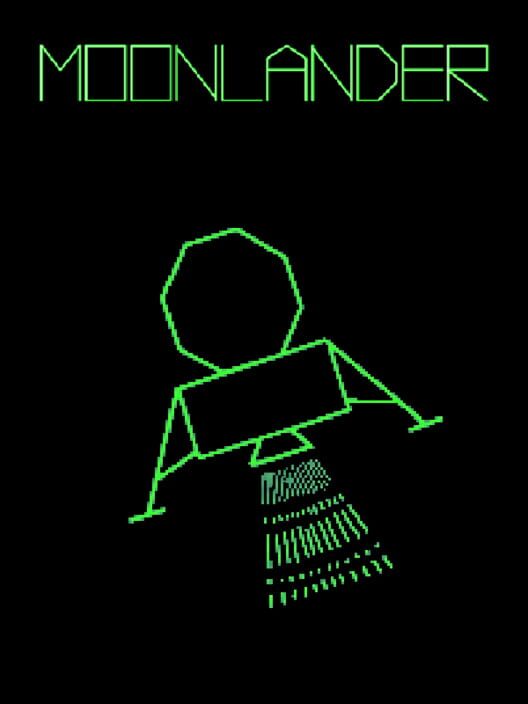
The original Lunar Lander game was a 1969 text-based game called Lunar, or alternately the Lunar Landing Game. Lunar Lander was originally written as a text-based computer game in the FOCAL programming language for the Digital Equipment Corporation (DEC) PDP-8 computer by Jim Storer while a student at Lexington High School (Massachusetts) in the autumn of 1969.
Storer submitted the game to the DEC users' newsletter, which distributed the source code to readers. Other versions of the concept were written soon after: a version called Rocket was written in BASIC by Eric Peters at DEC, and a third version, LEM, was written by William Labaree II in BASIC, among others.
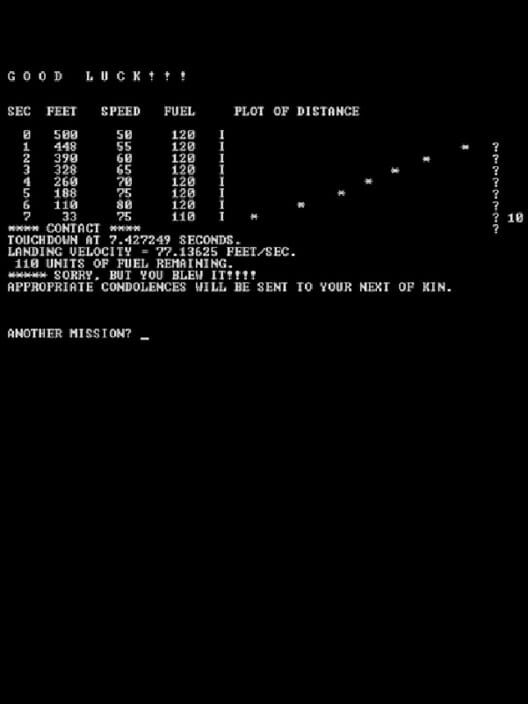
A full game of Rocket, one of the early versions of the game type. The player has only spent fuel at the last moment, and as a result has crashed into the moon.
All three text-based games require the player to control a rocket attempting to land on the moon by entering instructions to the rocket in a turn-based system in response to the textual summary of its current position and velocity relative to the ground. In the original Lunar, players controlled only the amount of vertical thrust to apply, based on their current vertical velocity and remaining fuel, with each round representing one second of travel time. Rocket added a simple text-based graphical display of the distance from the ground in each round, while LEM added horizontal velocity and the ability to apply thrust at an angle. In 1970 and 1971, DEC employee and editor of the newsletter David H. Ahl converted two early mainframe games, Lunar and Hamurabi, from the FOCAL language to BASIC, partially as a demonstration of the language on the DEC PDP-8 minicomputer. Their popularity led him to start printing BASIC games in the DEC newsletter, both his own and reader submissions.
Based on real world events of the lunar landing in 1969.
La vidéo est chargée depuis YouTube au clic.